Daily Blog from Eugene
byJames J. O’Brien
GREAT THINGS ARE HAPPENING
Saturday, July 23rd
By James J. O’Brien
Today is my last day at the World Track and Field Championships. The final day of competition is tomorrow; but, by the time that gets underway, I will be most of the way back to New York. (A 5:11am flight with a seven-hour layover in Phoenix. Don’t ask). Today is also the final day of competition for the New York Athletic Club, with Will Claye going in the final of the men’s triple jump.
This event has the potential to evolve into an enthralling battle, given that the incomparable Christian Taylor (four-time world champion, two-time Olympic champion) is not back to full force after rupturing an Achilles tendon last year. Taylor contested the qualifying round, but did not make the final. Claye advanced in 10th position with a leap of 16.70m/54-9.5, well shy of his best this year (17.19m/56-4.75) and even more well shy of his all-time best, the 18.14m/59-6.25 that he jumped in 2019, the third longest of all time. But factor the three Olympic medals (two triple jump and one long jump), the four World Championships medals (all TJ) and the two World Indoor Championships medals (TJ) and it is evident that Claye has the weaponry to do some damage this evening.
Inevitably, he is not alone. Pedro Pichardo from Portugal and Hugues Fabrice Zango from Burkina Faso both have PBs beyond 18m/59-0.75 and both have jumped further than Claye this year (Pichardo 17.49m/57-4.75; Zango 17.25m/56-7.25). Andrea Dallavalle from Italy has reached 17.28/56-8.5 this year, while Lazaro Martinez from Cuba has reached 17.64/57-10.5 indoors and 17.30m/56-9.25 outdoors, signifying that, of them all, he may be the man best poised to reach the top step. In reality, though, this event is wide open. Pichardo was best in qualifying (17.16m/56-3.75), albeit by a single centimeter over Zango. So, this would be a good time not to bet the farm, if, in fact, you had a farm and were, in fact, considering betting it on something like a triple jump competition.
Pichardo, indeed, issued a statement of intent from the outset. Jumping second, he leaped to 17.95m/58-10.75, the farthest jump in the world this year and a mark that nobody else in the field could come close to in the first round. Zango claimed second at 17.55m/57-7 and Dallavalle third at 17.25m/56-7.25. Claye fouled his first attempt, as did half the entire field.
As he steadied himself for his second jump, Pichardo exhorted the crowd to lend their support, a welter of noise that he rode to 17.92m/58-9.5, just three centimeters shy of this first round jump. Jumping fourth, Claye experienced the same run-up difficulty on his second jump as he had on his first, registering another foul. Now the pressure was on. He needed a legitimate jump among the leading eight to earn the right to an additional three attempts. As Pichardo launched another big one, reaching 17.57m/57-7.75 – any one of his three of his jumps was sufficient to hold the lead – Claye logged a legal jump, but it was way below his hopes, reaching just 16.54m/54-3.25, a mark that left him in an eliminated 11th place, a certain disappointment and not illustrative of his global standing. So it goes, of course, that being the nature of competition. Notably, these biennial championships were Covid-delayed by one year, meaning that Claye, and all of these athletes, will have another opportunity for world titles when the meet takes place in Budapest next year.
Worth also noting, and possibly of some small consolation to Claye, Martinez – he with the potential to take it all – fouled all three of his jumps. I reference my earlier non-farm betting admonition. Also, and for the record, Pichardo took the gold medal with his opening jump of 17.95m/58-10.75, Zango held silver at 17.55m/57-7 and Yaming Zhu from China took the bronze medal at 17.31m/56-9.5.
With that, NYAC participation at these world championships has come to a close. Eight Club athletes took part – Miranda Melville, Joe Kovacs, Sam Mattis, Tori Franklin, Valarie Allman, Will Claye, Kara Winger and Rudy Winkler. Every single one of them competed in finals; four of them – Kovacs, Winger, Franklin and Allman – won medals. At the time of writing, only five countries had more than four medals, a statistic that allows a clear perspective of the standard at which the New York Athletic Club’s athletes compete.
It has been a privilege to watch these elite eight compete throughout this past week, as it will be to follow their exploits in the coming seasons, as these, and all of the Club’s athletes, build towards the Paris Olympic Games, which begin two years from this coming Tuesday, on July 26th, 2024. The race is on in both the literal and figurative sense, and the NYAC’s athletes will be in the thick of the action. You can follow them all in The Winged Foot magazine, on our coming-soon NYAC Athletics web site, in our weekly NYAC Athletics News e-mails and via the Club’s social media platforms. Al Oerter observed, “Great things are expected of you when you wear the winged foot.” Unquestionably, as we saw in Eugene all week long, great things are happening.

JAVELIN SILVER FOR WINGER
Friday, July 22nd
By James J. O’Brien
Here is an interesting item of information for the statistically inclined: with three days of competition remaining at these world championships, and as I write these words, the NYAC stands equal sixth in the medal table behind the USA, Ethiopia, Jamaica, China and Kenya, alongside the UK and Netherlands. This evening’s competition has still to begin; but, as of now, the Club’s medal tally comes courtesy of Joe Kovacs (shot put, silver), Tori Franklin (triple jump bronze) and Valarie Allman (discus, bronze). Canada, Japan, Spain, Brazil, Israel – these are just a few of the nations with a tally below that of the NYAC. When you think about it, that is remarkable. Here’s what our remarkable athletes have had to say about it.
Joe Kovacs – “I had to try to bring my best. We [Kovacs and winner Ryan Crouser] battled back and forth. We always say we’re the best shot put country, and today we proved it. As US shot putters, it is our duty to come back with a medal. This is my sixth championship and I’ve got six medals. I’m super excited to go to Budapest [for the World Championships] next year. “Kovacs” is Hungarian. I have some family over there. I hope to put in a good performance.”
Tori Franklin – “This is amazing. It has been long and tough couple of years for me. I have gone through a lot and I am happy that I am finally competing to the best of my ability. And I know there is so much more to come. I feel really blessed right now to be among these special women.”
Valarie Allman – “Truly, it is bittersweet. Coming to these championships, I was so excited to represent my country and showcase the work that me and my coach have been putting in. But it was a good fight. We have spent so much time preparing for this competition. I feel like the season has been defining my self confidence. I was ready to compete for gold again [Allman won Olympic gold in Tokyo], but I just could not find that big throw. It’s good to walk out with a medal but I am definitely ready to compete again next summer in Hungary and go for the world title. After winning in Tokyo, I was very excited coming here, fighting for the gold; but, hopefully this will lead to new, exciting things.”
Kara Winger and Will Claye are still to compete here in Eugene, Winger this evening in the women’s javelin and Claye tomorrow in the men’s triple jump. If the stars align, both have the potential to claim some hardware and to boost the Club’s medal tally further. An interesting fact, pointed out by Track and Field Chair, John Schutty, is that all of the Club’s eight athletes competing in Eugene have made it to finals. (OK, Miranda Melville in the 20K and 35K race walks, did not, obviously, have to contest qualifying rounds; but hers were finals, nonetheless; so that counts).
Winger’s competition kicks off tonight at 6:20pm, an event that, as previously noted, will be the last major championship competition of her career. A four-time Olympian and six-time World Championships participant, Winger has all the experience to make this one count, and the opportunity is distinctly there. Coming into this competition, the NYAC woman had the sixth farthest throw of the year, 64.26m/210-10, which she set in this stadium at the Trials a month or so ago. Of the five women ahead of her on the list, only one, Haruka Kitaguchi from Japan is in this final. Remarkably, the world leader, the USA’s Maggie Malone, did not advance. That is not to say that there are easy pickings in this event; far from it. The Olympic champion, Shiying Liu from China, is in the field, as is defending champion, Kelsey-Lee Barber from Australia. All it means is that there is opportunity; most often, that’s all a world class athlete needs.
It was Barber’s Australian compatriot, Mackenzie Little, who put her stamp on the javelin field from the outset, reaching 63.22/207-5 with her first throw. Barber reached 62.67m/205-7, while Kitaguchi hit 62.07m/203-7. Winger’s first reached 56.93m/186-9, considerably shy of her season’s best, leaving her in eighth. The NYAC woman’s second throw was more of what she wanted, however, reaching 61.96m/203-3 to bring her up to fourth, behind Little, Barber and Kitaguchi. A third throw of 61.00m/200-1 saw her remain in fourth; but a monster 66.91m/219-6 from Barber caused a 1-2 flip at the front of the field, putting Barber in the lead, Mackenzie second and Kitaguchi third. At this stage, the field was pruned to the leading eight, who each received three more attempts, the watershed at which things become seriously serious.
Shiying Liu was the first to give evidence of that fact, hurling the spear to 63.25m/207-6 and moving herself into the silver medal position, a move that shunted Winger, who reached 58.78m/192-10 on her fourth, back to fifth. With the pressure on, however, the only person who improved in the fifth round was Winger, who launched a major 62.17m/203-11, to move back up to her previous fourth position, just over one meter shy of the medal podium.
On reflection, it was only now, in the sixth and final round, one throw remaining, that things started to get truly serious. On her very last throw, Kitaguchi hit 63.27m/207-7, moving from fifth into the silver position and dramatically nudging Liu back to bronze. Barber still held the lead, Kitaguchi was now in second, with Liu third, Mackenzie fourth and Winger fifth. Next in the throwing order was Winger. She stepped onto the strip with the stadium afire with raucous fans. Maybe it was the Richter Scale-force tremors running through the bleachers, maybe it was those stars coming into alignment; whatever it may have been, on her very last throw of this competition, on the very last throw of her lengthy professional career, Winger launched a rocket that will be the throw that she remembers above all of the thousands of others.
When the javelin came to land, it had reached 64.05m/210-1, a figure that sent the stadium into a renewed paroxysm. In a stunning turn of events, Winger had moved into the silver medal position, a placing that, were she to hold it – others still had to throw – would be the first major championship medal of her lengthy career. She held it, a spectacular conclusion to a remarkable competition and a stellar career.
“I really just wanted to improve my performance in front of the home crowd,” stated Winger. “I really thought that Tokyo [the Olympic Games] would be the top of my career. This has been an absolute dream. I just had so many opportunities and so much support from the local crowd. To grab a medal here, almost at home, at Hayward field, it is what I dreamed about. I am still it disbelief that it actually happened.”
It seems that I now have to go back and re-tabulate the medal table. That’s a problem I am very happy to have.

A Lot of Beauty
Thursday, July 21st, 2022
By James J. O’Brien
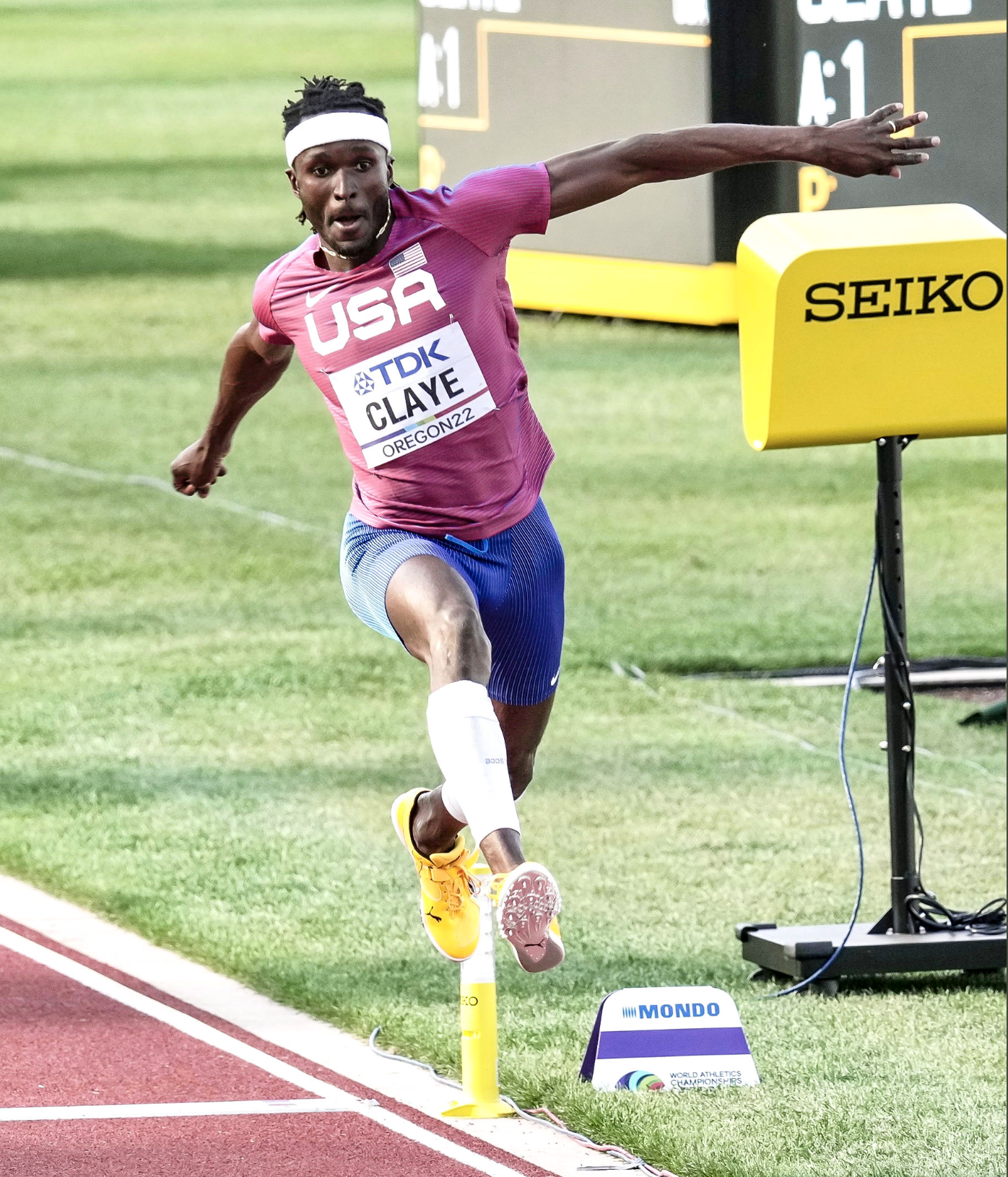
Today is a relatively quiet day from an NYAC perspective, the Club’s sole competitor being Will Claye in the qualifying rounds of the men’s triple jump. I have opined ad nauseam that there is no such thing as a sure thing; but, on paper at least, this round should be a perfunctory outing for Claye. The stats don’t lie. Coming into this meet, he was ranked sixth in the world; his personal best of 18.14m/59-6.25, set in 2019, is the third best of all time; he has two Olympic silver medals (2012, 2016), plus a long jump bronze (2012); he is a two-time world indoor champion; and he has four world outdoor championship medals (silvers in 2017 and 2019; bronzes in 2011 and 2013). That, you might say, is a resumé. There is more, as you will note if you visit the bios page—Claye is also a recording artist and owns his own fashion brand, “Elevate.”
The NYAC man did what he was called upon to do in this evening’s qualifying rounds, sailing into Saturday’s final with a third round jump of 16.70m/54-9.5 that made him the 10th qualifier. The next round—the final—is, of course, where things will become decidedly more complex. Claye’s best performance this year (17.19m/56-4.75) came at the World Indoor Championships in Belgrade, Serbia in March, and it is not among the top 10 marks in the world this year.
Four-time defending champion and two-time Olympic champion, Christian Taylor, was on the runway this evening, but having not fully recovered from a ruptured Achilles tendon last year, he did not make the final. This opened a window of opportunity for a gaggle of hungry jumpers, most prominent of whom may be Lazaro Martinez from Cuba and Pedro Pichardo from Portugal, the world #1. Truth be told, with Taylor out, this event could go any of half a dozen directions, with no reason at all why Claye would not be deep in the fray. Personally, I had hoped that Abdulla Aboobacker Narangolintevida from India would be in the mix, but he didn’t make the cut.
So, we await all of that action on Saturday. Before then, of course, comes Kara Winger in the women’s javelin final on Friday. As mentioned in yesterday’s blog, this will be a sentimental outing for the NYAC woman, this being her last major championship prior to retirement. She certainly has the capability of forcing her way onto the medal podium, though it will be no easy task. Which, needless to say, is the way it’s supposed to be.
In closing, it is worth reflecting on an aspect of this meet, or any other world championships meet, that may not transpose to TV coverage: the championships’ mascot. Here, in Eugene, that individual goes by the name of “Legend,” for reasons that remain unclear. Legend is a human (we presume) encased in a costume that evokes a cross between Yogi Bear and Fozzie Bear. The bear look is, evidently, what they were going for. In fairness, as annoying as Legend can be, he/she/it has got some serious dance/gymnastics moves (including handstand push-ups!) that have set a high bar for future championships’ mascots. Legend has also been swimming in the steeplechase water jump and, this evening, building sandcastles with a kid in the long jump pit. Yes, he’s annoying, but it’s impossible not to smile, as much as I try not to. That said—and this has been discussed among journos within my seated orbit—Legend has yet to come close to Berlino, the mascot for the 2009 World Championships in, of course, Berlin. It would be impossible to explain what Berlino got up to, but a YouTube search will reveal much detail. You can decide.
Back in Eugene, it has been reported that, a couple of days ago, an accredited individual stole Legend’s head. This begs so many questions, but the Eugene police have been on top of the issue, so we were told, and the head has since been retrieved and, presumably, re-attached. He/she/it looked fine this evening.
All of this extraneous entertainment is, of course, just that—a distraction from what these championships are about: excellence in its purest form. The world’s greatest line up against each other on a predetermined day and at a predetermined time, just to see who is best. They are gunslingers, each taking their best shot on a single day that counts. There’s a lot of beauty in that.
Discus Bronze for Allman
Wednesday, July 20th, 2022
By James J. O’Brien
Today is by far the hottest day we have had, so far, at the World Track and Field Championships. As I write these lines at 4pm, it is 90 degrees. The women’s javelin qualifying rounds are underway on the infield, and those athletes are unquestionably frying in the cauldron.
Embroiled in the competition—or maybe broiled—is the NYAC’s Kara Winger, a four-time Olympian, a nine-time US champion (including this year at the World Championships Trials) and a sentimental favorite, given that this is her last major championship prior to retirement. Winger is competing with a brace around her left leg, although that appears to impede her not in the least. The first of her allotted three throws was a mediocre 58.12m/190-8, but she followed that with a stellar 61.30m/201-1, which moved her into second position behind Lithuania’s Liveta Jasiunaite (63.80m/209-4). Winger retained this placing at the conclusion of the competition.
This was the Group A qualifying round, from which you may infer that there is also a Group B. How it works is that the top 12 combined from those two groups advance to the final, as well as anybody who exceeds 62.50m/205-1. While Winger is almost certain to advance based on her second placing, that won’t be made official until the Group B competition has been completed in another hour or so. In the meantime, we wait. But, in reality, she’s in. The final is on Friday at 9:20pm EST.
Winger commented: “I felt really good warming up outside of the stadium and a little flat inside, so I know what to focus on. I hope for the final, because I have thrown further in qualification and not made it to the final. I used to be the furthest Olympic qualification mark not making the final, so I hesitate to celebrate immediately. But, based on this season’s results, I feel OK. I am pretty confident about throwing in the final. I just have to make it through.”
Winger isn’t the only NYAC athlete competing today; on the horizon is a performance from Valarie Allman, the Olympic discus champion and 2022 world leader, courtesy of the 71.46m/234-5 US record that she set in April. Allman is seeking to add the world crown to her Olympic title and is as powerful a favorite as any in these championships. However, she did log two fouls in qualifying, only advancing thanks to a clutch final attempt (albeit an intimidating 68.36m/224-3). So, anything can happen. Her greatest challenges will likely come from two-time Olympic and two-time world champion Sandra Perkovic (CRO), 2019 world champion and Tokyo 2020 bronze medalist Yaime Perez (CUB) and Tokyo 2020 silver medalist Kristin Pudenz (GER). The only sure thing about this is that it’s sure not going to be easy.
While we wait for the discus final to kick off, the official results of the women’s javelin qualifying are in, with Winger advancing as the fourth farthest thrower. Ahead of her is Jasiunaite (LTU) from Group A and Haruka Kitaguchi (JPN) and Shiying Liu (CHN), both from Group B. Surprisingly, the USA’s Maggie Malone, the 2022 world leader, did not make the cut. Just shows.
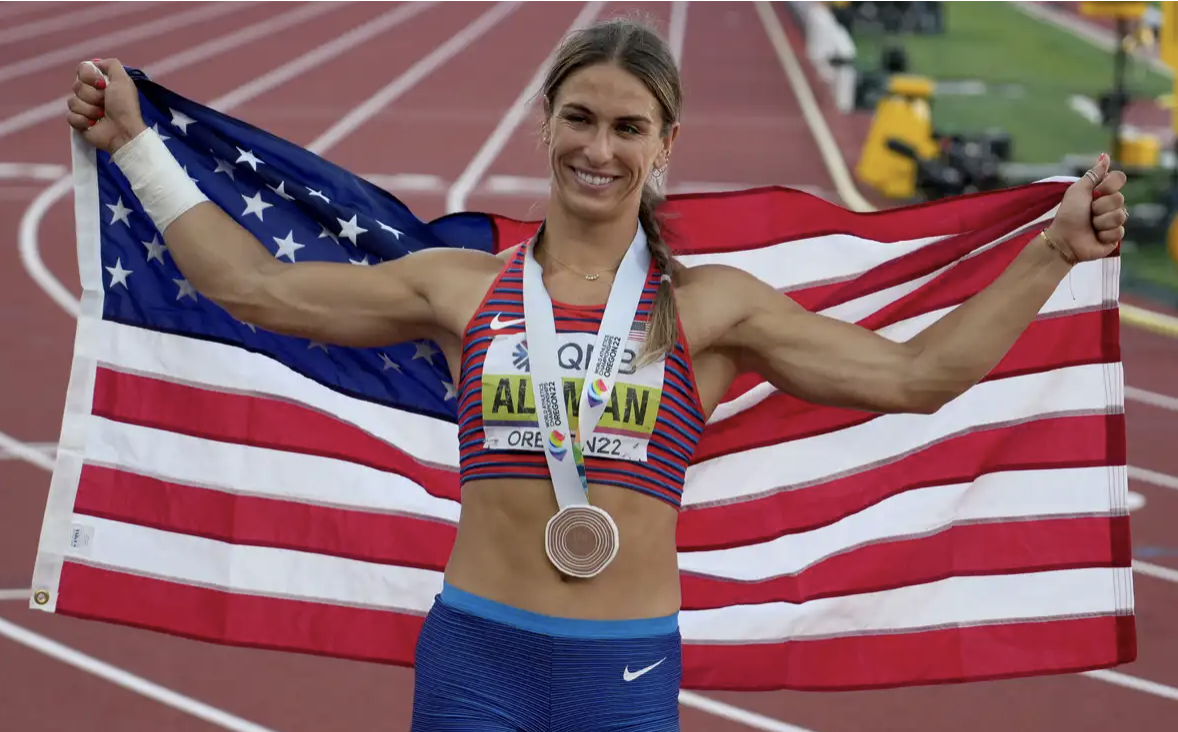
At 6:30pm local time, the discus final got underway, and the sparks flew almost immediately. Throwing fifth, Allman launched an intimidating 67.62m/221-10 that placed her at the head of the field from the outset. Her delight was evident as she left the circle. Throwing sixth, however, was the aforementioned Sandra Perkovic, who lashed the implement out to 67.74m/222-3, shunting Allman back to second. Perkovic was comparably delighted, that is, until China’s Bin Feng hit 69.12/226-9, a massive three-meter personal best and an intimidating statement of intent. This year, only Allman has thrown farther.
Into the second round, Allman reached 66.47m/218-1, while Perkovic launched a big 68.45m/224-7, improving her first round throw, but keeping her in the silver medal position. Feng, who placed fifth in the 2019 World Championships and did not make the final in Tokyo 2020, fouled her second, meaning that, at the end of round two, there had been plenty of action but no changes. Into the third round, with the crowd urging her on, Allman fired out an attempt that looked as though it was approaching the 70-meter line. It was, but not enough. The mark, 68.30m/224-1, represented an improvement, but still left her 15 centimeters shy of Perkovic, who fouled her third but held second. Feng’s third landed at 66.89m/219-5, no improvement. Thus, halfway through this competition, with things getting tense, the positions remained as they had been from the outset.
Into round four, with the field pruned to eight, Allman’s throw was another big one, 68.05m/223-3, but not big enough to make a difference. Perkovic hit 67.74/222-3 and Bing 65.88/216-2; so, again, no change.
Round five—two throws left. Allman fouled, Perkovic hit 66.59m/218-5 and Feng reached 65.60m/215-3. Once again, the athletes remained in their initial positions. Each of them had a single throw left and all to play for. The moment the disc left her hand for the sixth time, Allman knew it was not to be. The mark was just 51-41m/168-8, and as she exited the circle, the disappointment was etched on her face, an emotion that was understandable, though hardly 100 percent justified. In claiming a bronze medal, Allman is the first US woman ever to reach the world championships podium in this event. For the record, in that last round, the positions remained unchanged, with Bing taking gold and Perkovic silver.
Reflecting on the evening’s action, while Allman may not have obtained the result that she sought, she certainly did affect the outcome that the NYAC expected: to compete well and to challenge the greatest athletes in the world. In doing so, she walked in the footsteps of arguably the greatest discus thrower of all time, the NYAC’s Al Oerter, adding to the athletic legacy of the club that is privileged to call her a member.
THE STARS HAVE TO ALIGN
Tuesday, July 19th, 2022
By James J. O’Brien
We are five days into these world championships, so maybe this is a good time to review what has happened thus far. Here it is, in a nutshell:
Day 1 – Friday, July 15th
Joe Kovacs (shot put) and Rudy Winkler (hammer throw) contested their qualifying rounds; both advanced to finals with respective throws of 21.50m/70-6.5 and 78.61m/257-11, both automatic qualifiers. Miranda Melville competed in the women’s 20K race walk, placing 35th (1:39:58).
Day 2 – Saturday, July 16th
Rudy Winkler went in the final of the hammer throw, placing sixth (78.99m/259-2). Tori Franklin competed in the qualifying rounds of the women’s triple jump, advancing to the final with a 14.36m/47-1.5 leap that placed her ninth of the qualifying 12.
Day 3 – Sunday, July 17th
Joe Kovacs took the shot put silver medal (22.89m/75-1.25) after an epic battle with US team mate, Ryan Crouser. Sam Mattis contested the qualifying rounds of the men’s discus, reaching 65.59m/215-2 to install him in eighth of the 12 men to advance.
Day 4 – Monday, July 18th
Tori Franklin took a magnificent bronze medal in the women’s triple jump, thanks to a season’s best 14.72m/48-3.5. Franklin was just two centimeters ahead of fourth placer Layanis Perez Hernandez from Cuba—a tiny difference, but precisely the distance between the podium and the spectators’ seating. Valarie Allman fouled twice in the qualifying rounds of the women’s discus, but she made her last throw count, reaching 68.36m/224-3 to become, by far, the leading qualifier for the final.
So, here we are, about to begin Day 5 with two NYAC medals already secured. When it comes to tabulating the hardware, it can be sobering to bear in mind the words of Swiss Olympic skier Pirmin Zurbriggen. I interviewed Zurbriggen in 1987, less than one year prior to the Calgary Winter Games in which he was expected to return home with a trove of medals at which even a Swiss banker might baulk. In the end, Zurbriggen claimed a gold and a bronze. One journo (not me) had the temerity to ask him what had happened. Zurbriggen replied, “I got lucky.”
This is to say that medals at major championships are only claimed by a very, very precious few of the crème de la crème. It is an exclusive group derived from an exclusive group. After just four days, the NYAC can take pride in the fact that it has already seen two of its athletes on the podium; that’s two more than most countries here. As we look ahead toward the impending competitions, therefore, it is appropriate to bear in mind that, were this meet to end today, we may deem it a major winged foot success.
Thankfully, the meet is far from over, and we may keep hopes alive for still more success. Sam Mattis is in the circle this evening for the final of the men’s discus, an event in which he ranked sixth in the world this year, courtesy of an early season 68.69m/225-4. Sweden’s Daniel Stahl is the marginal favorite to take the crown, seeing as he is the world leader, not to mention the Olympic and defending world champion. What will make this competition especially interesting is that snapping at Stahl’s heels is Slovenia’s Kristjan Ceh, who has won 12 of his 13 competitions this year, who has thrown over 70 meters three times (Stahl has accomplished this twice), and who has beaten Stahl in five of their six clashes this year. To say that this will be a nail biter would be a considerable understatement.
While the front runners are embroiled in their battle for gold, they would be foolish to overlook the challenge of Mattis who, though he placed third in the US trials, is most likely the strongest of the US contenders and whose 68.69m 2022 PB should put him in the mix. In reality, the outcome of a competition at this level comes down to several years of excruciating training, a comparable number of years of competitive experience, a healthy amount of blind faith, a little bit of luck, and whether the stars are aligned on the day. If you’ve got all of that in your tool bag, you’ve got a shot.
At the end of the first round, Lithuania’s Andrius Gudzius, who placed sixth in the Tokyo Olympic final, held the lead with a throw of 67.31/220-10 while his compatriot Mykolas Alekna was poised in second (66.64/218-8) and Stahl in third (66.59/218-5). Ceh hovered in sixth (65.27). Mattis had a rough first attempt, reaching just 60.89/199-1 to leave him in 11th.
The front of the field came alive when Ceh launched a powerful 60.02/196-11, advancing him into the lead, while Alekna and Gudzius remained in second and third. Stahl could not improve, nor could Mattis, who labored in fifth and 12th respectively.
In round three, Stahl fired out a 69.16/226-11 that appeared to offer a powerful riposte to Ceh, but the throw was ruled a foul and the defending champion remained in fifth. Ceh, for his part, powered onward, launching a massive 71.13m/233-4 on his third attempt, drawing a line in the sand for his competition.
For Mattis, it was do or die in this round. He needed to produce a mark that would move him into the leading eight in order to earn an additional three throws and a shot to move into contention. After three attempts in the throws, placings nine to 12 receive a hearty handshake and, well, that’s about it. Sad to say, that was how it unfolded for the NYAC man. His third and final effort reached just 62.82m/206-1, leaving him in 11th place and marking his exit from the competition. I refer readers to a few paragraphs back: even with years of training, dedication and competitive fervor, the stars still have to align. Sometimes they don’t. For the record, Ceh’s third round throw was the one that took the gold, with Alekna claiming silver and Gudzius the bronze.
We can hope that the stars align perfectly for Valarie Allman tomorrow evening. That is when the NYAC’s Olympic discus champion will seek to add the world title to her trove. The portents are good: Allman set the US record at 71.46m/234-5 in April of this year. That mark is also the 2022 world leader. However, I won’t say any more about that for now. Hexing is not something I intend to do. Also on deck tomorrow is Kara Winger in the women’s javelin qualifying. Winger is ranked fifth in the world coming into this meet, and she won the US trial ahead of the world leader, Maggie Malone. Winger has stated that this will be her last major championship. Were she to win a medal, it would be her first in a world championships or Olympic Games and certainly an appropriate conclusion to a long and storied career. Fingers crossed. Sometimes that works.

TRIPLE JUMP BRONZE FOR TORI FRANKLIN
Monday, July 18th, 2022
By James J. O’Brien
Transplant a couple of thousand athletes to a hyper-competitive environment a long way from home and some weird and wonderful things are certain to happen. Take last night, for instance. A thrilling men’s shot put competition saw the NYAC’s Joe Kovacs claim the silver medal. As remarkable as Kovacs’ clash with Ryan Crouser was, gilt was added by the fact that Americans went 1-2-3 in the event for the first time in world championships history. (Josh Awotunde claimed the bronze). A clean sweep in any event is a remarkable feat, but last night it also happened in the women’s 100m, with all medals going to Jamaica. The night before, in the men’s 100m, all of the medals went to the USA. In the 18-edition history of this meet, three medal sweeps have happened only three times at a single championships: 1983, Helsinki; 2005, Helsinki again; and, Osaka, 2007. Here in Eugene, we have had three sweeps in just two nights. More are likely.
In other curious news, with a two-hour window this morning, it occurred to me that an appropriate thing to do in Tracktown USA might be to go for a run. Not that there’s anywhere good to run near my hotel, which is adjacent to a highway exit ramp and a gas station, but that’s no reason not to try. Plus, there’s no better way to get the lie of the land in a new city. For the record, the lie of the land on the perimeter of Eugene is lying at a distinct angle; either sharply up or sharply down. But, again, not an excuse not to go. So, I did.
In 50-plus years of running, I have been chased by all manner of beings. There was the gang of thugs with a very large monkey wrench. There has been just about every breed of dog. A few cows, one time. Even a horse and a goose. I’ve never been chased by a cat, though. At least, not until today. For my part, I was just trundling along, minding my own business, something to which this tabby evidently took serious exception. Before I knew what was happening, the four-legged fiend was barrelling towards my legs with a look of outrage in its eyes. I can only presume that the look of surprise in my own eyes was what stopped it in its tracks, as, for no evident reason, it then sat down in the middle of the road and watched me continue on my way, I’m guessing keeping an eye on me to ensure I didn’t come back. I won’t. It looked seriously mean.
Enough of that. What we’re here for is track and field action, of which we have plenty this evening, courtesy of Tori Franklin in the final of the women’s triple jump and Olympic champion Valarie Allman in the qualifying rounds of the women’s discus. Franklin comes into the competition ranked #18 in the world and with a personal best of 14.84m/48-8.25 from 2018. While nothing is assured, it will be a major upset if the gold medal in this event does not go to Yulimar Rojas from Venezuela. Not only is Rojas the Olympic champion, a five-time world champion (three indoors, two outdoors) and the world record holder (indoors and outdoors), but she also holds the season’s best mark by almost a full meter. Rojas challenges Ryan Crouser for title of “most dominant.” (See yesterday’s blog). Realistically, then, Rojas should have this sewn up, insofar as that is possible with everybody else, including Franklin, fighting for the minor placings. Then again, who’s to say? Nothing is certain. She could get attacked by a house cat.
As for Allman, if things go according to plan, today will be perfunctory. The automatic qualifier to advance to the discus final is 64.00m/210-0. Allman’s all-time best is the US record of 71.46m/234-5 that she set this year and that gives her a seasonal advantage of over three meters on the #2 performer of 2022, four-time world champion, Sandra Perkovic from Croatia. None of this is to imply that the competition will be easy—there will be plenty of contenders snapping at Allman’s heels; but the real intensity will, most likely, not unfold until Wednesday’s final. Today, Allman should be able to clear 64 meters from a seated position and advance comfortably.
As I write this, Franklin’s and Allman’s competitions are still a couple of hours away. Stand by.
Well, as things transpired, Allman did not make it as easy as we would have hoped. After fouling her first two of three attempts, it was all or nothing in round three. This time, however, she made it count in demonstrable terms, reaching a comfortable auto-qualifying 68.36m/224-3, which not only advanced her to the final but also brought a palpable look of relief to her face. And mine; just saying. The women’s discus final takes place on Wednesday at 9:30pm EST.
In the women’s triple jump final, Rojas put her stamp on the competition early on, as expected. Jamaica’s Shanieka Ricketts, the silver medalist in this event in 2019, took the first round lead at 14.89m/48-10.25, but Rojas ensured that this was a temporary state of affairs. Rojas landed at 15.47m/50-9.25 on her second attempt, a mark only she has exceeded this year and just three centimeters shy of the championship record.
Franklin, however, was embroiled in a medal battle of her own. With two rounds gone, she held third position, courtesy of a 14.53m/47-8 opener. In round three, though, Cuba’s Leyanis Perez Hernandez reached 14.70m/48-2.75 to push the NYAC woman back to fourth. But with the top eight receiving three additional jumps, the scores were far from settled.
As round four began, the standings were Rojas, Ricketts, Perez Hernandez and Franklin, with the USA’s Keturah Orji in fifth and working hard to get into contention. Franklin fouled her fourth attempt, leaving her still one shy of the podium as round five began. But she made amends on her fifth attempt, reaching 14.72m/48-3.5 and hauling herself back into the bronze medal position. Rojas and Ricketts still held gold and silver, but with one round remaining, the pressure was on for the third placing, with Perez Hernandez just two centimeters shy of Franklin. On her last attempt, the Cuban could not improve, and the NYAC bronze medal was assured, Franklin’s first major championship medal. On her sixth and final attempt, Franklin launched a monster that looked for one moment as if it would have brought her to silver, but the red light flashed, signifying a foul. That dimmed her accomplishment not at all, however; a magnificent bronze medal was captured, after all, in the heat of world class competition. Rojas claimed her third world championships outdoor gold, Ricketts retained the silver, and Franklin sent a message that they should not rest on their laurels.
With Joe Kovacs taking shot put silver yesterday, with Tori Franklin taking bronze today and with Valarie Allman going for discus glory tomorrow, it is fair to say that the winged foot’s track and field athletes are, in the most understated terms, following the tradition.

THE WORLD COMES TO EUGENE
Sunday, July 17th, 2022
By James J. O’Brien
These World Championships are the 18th edition and the first ever to be held in the USA. To this point in time, the meet has been held in corners of the world as diverse as Daegu, Doha, Helsinki, Moscow, Beijing and London; but, never in the USA. Some may deem that unusual, given the traditional strength in depth of Team USA. Truth be told, though, the sport of track and field in North America is very much a poor relation when stacked up against the big four: football, baseball, basketball and hockey. In Europe and much of the rest of the world, track and field (athletics, as the sport is more universally known) gives best only to soccer (football, as it is more universally known) and can effectively fight its corner against swimming, cycling and miscellaneous other popular sports. That being the case, it may be less surprising that this event has taken so long to establish a truly powerful foothold in the United States.
The awarding of this meet to Eugene did not come without its share of controversy, however, and still suffers considerable scrutiny and criticism, even with the meet successfully underway in the University of Oregon’s storied Hayward Field. World Athletics supremo, Lord Sebastian Coe, has made no secret of his intent to entrench his sport more deeply in the American market; in this instance, it is his strategy that has been called into question.
Essential to any major event, especially one seeking to carve its place in the universe, is to seek a host city that can be accessed with reasonable facility and that has the infrastructure to handle an influx (hopefully) of athletes, officials, sponsors, media and fans from all around the world. Eugene and Hayward Field have many attributes that make them an attractive track and field venue; sadly, none of the above fall into that category. Few direct flights (I will save the travails of my own journey for another time), few hotels, few restaurants, minimal public transport; Eugene is a charming community, for sure, but lacking in many essentials that are fundamental to bringing this global sport to a higher peak in the USA.
The brand new stadium, purpose built for this event, is unquestionably attractive; but as I sit here for today’s morning session, the highlight of which will be the men’s 10,000m final, I would guess that 50% of the seats are empty. Undoubtedly, this evening’s session, in which Joe Kovacs seeks to defend his world title, will see better attendance; but, for now, there are significant elements that are distinctly lacking.
Fuel to the critics’ fire is that Stockholm, a city with all of the aforementioned infrastructure, plus a lengthy track and field tradition, had intended to bid to hold these championships, but was summarily rebuffed. The deal had already been done with Eugene. The Swedes, understandably, were seriously miffed, which got them exactly nowhere. So, here we are in Eugene, aka Tracktown USA.
As I write this blog (on Sunday morning), two days of competition have already taken place, both of which featured NYAC athletes, Miranda Melville in the women’s 20K race walk, which took place on Friday morning, and Rudy Winkler in the men’s hammer throw final on Saturday morning. I only arrived in Eugene at 3am this morning – ref: the aforementioned nightmare journey – so would not have been able to report on those events; however, I will take this opportunity to catch up.
The 20K race walk final was always going to be a tough outing for Melville. With a personal best time of 1:31:42 from 2016, the 2016 Olympian was facing a flotilla of competitors with considerably faster marks on their resumés. So, it proved. While Kimberly García León claimed Peru’s first ever gold medal at the World Championships, setting a national record of 1:26:58 in the process, Melville worked hard to place 35th in 1:39:58, a brave performance, but not one with which she will be satisfied.
Similarly, Rudy Winkler may not be completely happy with his sixth place finish in the men’s hammer throw final, which took place yesterday morning. Having set a US record of 82.71m/271-4 earlier this season, Winkler could have been justified in setting his sights high. With three of his five legal throws all over 78m, he was nothing if not consistent; but, the NYAC man could not uncork the big one that would put him on the podium. His ultimate finishing place and mark of 78.99m/259-2 was still a fine performance, but was well down on Pawel Fadjek from Poland (81.98m/268-11) who claimed his fifth consecutive hammer throw world title.
At this stage, I must, in fairness, note that the stadium has filled considerably from what it was two hours ago. There is hope, therefore, if not expectation, that things will catch fire this evening when the aforementioned Kovacs takes to the circle for the men’s shot put final. To be frank, it will be an upset if anybody other than the USA’s Ryan Crouser takes the gold medal this evening. But memories of the 2019 final – the last time that this meet was held – remain vivid. Kovacs prevailed on that occasion, in a competition that has been hailed as the greatest of all time. Nothing is pre-determined. That’s why we will all be back here this evening to watch the drama unfold and, all being well, to see the stadium catch fire (metaphorically, that is).
Evening Session – Kovacs vs. the World
While the NYAC focus is distinctly on defending world shot put champion, Joe Kovacs, we should not forget that Joe is not the only Club athlete in the arena this evening. Also on deck is Sam Mattis in the qualifying rounds of the men’s discus. Ranked #9 in the world coming into this meet and with a new PR of 68.69m/225-4, Mattis should have little trouble advancing to the final; but I’m not about to jinx it right here. So, I’ll say no more until those rounds are finished.
As for Kovacs, mighty as he is, his work is cut out for him courtesy of his Team USA team mate, Ryan Crouser. The 2016 and 2020 Olympic champion, Crouser has stood astride this event in recent years in a manner rarely seen in any discipline. At the US championships in June, held in this same stadium, Crouser prevailed over the competition by almost 10 inches, a sizeable distance when it comes to throwing a 16lb implement. Second in that competition? Kovacs. Possibly more salient is the fact that nine of the top 10 performances of all time have been posted by Crouser in the last two years. “Dominant” seems like an inadequate adjective. That said, they don’t give out medals based on ranking lists; you’ve got to compete. Which is what Kovacs does really well.
But Crouser drew a line in the sand on his very first throw of the competition, launching a monster 22.21m/72-10.5, a mark only three other men in the world have reached this year. What did Kovacs think about that? 22.63m/74-3, that’s what, a distance only he and Crouser have seen in 2022. Josh Awotunde, also of the US, made a major launch in this first round (22.24m/72-11.75) meaning that, at the end of the first round, Kovacs held the lead from Awotunde with Crouser third. All to play for.
At least that’s what Crouser clearly believed. His second throw came back to earth at 22.71m/74-6.25, a definitive statement of intent. In response, Kovacs fouled and Awotunde could not improve, meaning that, with two rounds gone, Crouser held the lead with Kovacs second and Awotunde third. In round three, Crouser reached another big one – 22.58m/74-1 – while Kovacs could not improve. So, half way through this competition, Crouser led with Kovacs second and Awotunde still third. At this stage, the leading eight men received three additional throws, while everybody else sat back to watch the fireworks.
Round four was more of the same. Crouser looking in command, everybody else laboring hard to close the gap. It was in the fifth round that the sparks flew one more time, and one more time it was courtesy of Kovacs, who heaved a massive 22.89m/75-1.25 to take himself back into the gold medal position. Crouser was suddenly on the back foot, someplace he’s not accustomed to being. But nor was he for long. Now throwing immediately after Kovacs, he responded with a huge 22.94m/75-3.25, to put him back in the pole position. There was still one round to go and this was clearly going to go to the wire. Kovacs gave it his all in round six, but could not improve on his round five attempt, meaning that the final result was Crouser gold, Kovacs silver and Awotunde bronze.
Kovacs was clearly disappointed at having come so close. Consolation, if there is some may come in the knowledge that, once again, the NYAC man was involved in a shot put confrontation for the ages. For the record, Kovacs now has two Olympic silvers, two world championships golds and two world championships silvers, a trove that starkly illustrates a man who expects great things and then delivers.
In closing, and catching up with earlier news, Sam Mattis did indeed advance to the final of the men’s discus; thus, we will see him in action again on Tuesday evening. Before that, however, we have Tori Franklin in the final of the women’s triple jump, taking place tomorrow (Monday, which is probably today by the time you read this).
As for me, having only made it to Eugene at 3am this morning, I’m about to go and win a world championships gold in sleeping.
